


| River Traligill caves: | OS Sheet 15; NC 277206 |
| Allt nan Uamh caves: | OS Sheet 15; NC 268170 |
| Our Visits: | 19 August 1993 |
As you drive north on the A837 to Inchnadamph the escarpment to the east (right) is made up of Cambrian limestone. This is readily identified by the sudden appearance of springs low down on the hillside - noticeable after heavy rain - and the richer green pastures along the roadside. The rivers have cut underground tunnels and caves and, whilst not as extensive as the caves in Yorkshire, they are the best caves in Scotland and worth exploring on a rest day or when the weather is not good enough for mountain walking.
There are two sets of caves, the first on the River Traligill behind Inchnadamph, with a second series 4km further south on the Allt nan Uamh. These latter caves were excavated earlier in the 20th century and found to contain animal and human bones dated at 6000 BC. Access to the Traligill caves is easy following the track behind Inchnadamph past Glenbain. Beyond the end of the track the path forks, the left branch holding the north side of the river and taking you on to the summits of Conival and Ben More Assynt, whilst the right path passes a Nature Conservancy signpost and crosses the stream by a bridge. The most obvious feature is the disappearance of the river underground, leaving a dry bed, only to reappear some 400m further downstream. 700m further on, higher up on the hillside of the south side, three further caves can be found. The hardness of the Cambrian limestone has prevented the water eroding large caves, however you can climb inside the entrances so take a torch.
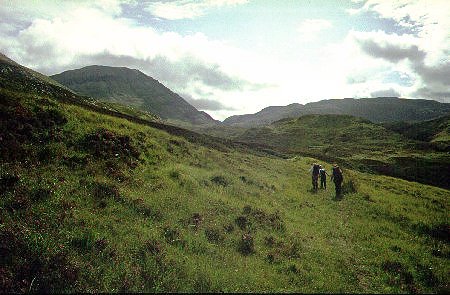
The weather was windy and overcast with the cloud hanging at 2500ft., showers and misty rain added to the generally miserable weather so it was an afternoon stroll, having had lunch in the car, to view the caves. It is only a short walk along the valley to the first stop, the point where the stream reappears from a caverous bowl; the riverbed is dry upstream. 400m further up the valley you can clambour down to the point where the stream disappears underground. You can get inside the cave entrance, where the water runs off down hill to the right, the caves clearly extend uphill to the left.
In the next cave you come to the stream runs through the base, a waterfall to the left (upstream) and a blow hole lies above. You can also clamber inside the final cave entrance in the series, it opens out into a second chamber under a low arch. Beyond this a small hole gives access to another chamber where the stream runs - not a spacious entrance but ample for a man.
Exploration of the cave entrances is good fun - especially for the children - so take a torch. However pothole caves are dangerous and should not be entered to any great depth. This is critical in Assynt where sudden rainfall can flood the tunnels very quickly indeed.
A more detailed description of the Assynt caves is given in pages prepared by the Grampian Speleological Group whose home pages give a more general review of caving in Scotland.