
| River Traligill caves: | OS Sheet 15; NC 277206 |
| Allt nan Uamh caves: | OS Sheet 15; NC 268170 |
| Our Visits: | 1 August 1998 |
As you drive north on the A837 to Inchnadamph the escarpment to the east
(right) is made up of Cambrian limestone. This is readily identified by the
sudden appearance of springs low down on the hillside - noticeable after heavy
rain - and the richer green pastures along the roadside. The rivers have cut
underground tunnels and caves and, whilst not as extensive as the caves in
Yorkshire, they are the best caves in Scotland and worth exploring on a rest
day or when the weather is not good enough for mountain walking.
There are two sets of caves of which the Allt nan Uamh caves are the ones reached first when travelling north; the second series are 4km further north on the River Traligill behind Inchnadamph. The local ranger service runs a series of guided walks to the site through the summer season.
 Visit to the Caves
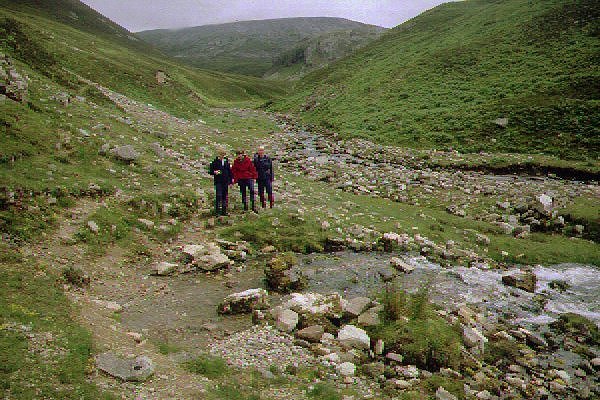
There is a car park next to a fish farm and a well built path follows on
the western side of the Allt nan Uamh upstream. It is only a short walk
of 1.5 km to the caves and it passes a small waterfall before reaching a large
spring at the foot of a scree slope. Here the water rises from the ground at
your feet - the flow forming the bulk of the water in the river. Just beyond
there is a second spring this time in the centre of the riverbed beyond which
the river is dry - it is quite odd how such a large valley (and in a summer of
extremely wet weather) has absolutely no water flowing along its base.
 You soon reach a point where
the path crosses the riverbed and climbs the short slope to the caves situated
under a large limestone cliff. There are four caves in all - two of which are
large and deep enough to walk inside. A short - and narrow - passage connects
two of them and Susan set about wriggling along between them for a bit of fun.
The view from the caves is impressive as they are comparatively high above the
valley floor - a herd of deer could be seen on the opposite hillside. The
second cave has a series of further sections running back beyond a hole about 6
feet deep - it was in this section that archeologists found animal and human
bones dating back to 6000 BC. Copies of the bones can be seen at the
Knockan Visitor centre a few miles to
the south. You can climb into the caves but you will need a good torch and not
mind getting dirty.
You soon reach a point where
the path crosses the riverbed and climbs the short slope to the caves situated
under a large limestone cliff. There are four caves in all - two of which are
large and deep enough to walk inside. A short - and narrow - passage connects
two of them and Susan set about wriggling along between them for a bit of fun.
The view from the caves is impressive as they are comparatively high above the
valley floor - a herd of deer could be seen on the opposite hillside. The
second cave has a series of further sections running back beyond a hole about 6
feet deep - it was in this section that archeologists found animal and human
bones dating back to 6000 BC. Copies of the bones can be seen at the
Knockan Visitor centre a few miles to
the south. You can climb into the caves but you will need a good torch and not
mind getting dirty.
The path continues along the escarpment a few hundred yards before dropping back to the valley floor and we returned below the caves on the way back to the car.


